How is an IRD Penalty Calculated?
May 21 2026
The big banks rarely explain this upfront, probably because it is such a confusing calculation. Try asking Google or Claude.ai and you will get a wide range of explanations, some of them incorrect. Or, try to find infomation about Prepayment Penalties on the bank's own website and you will probably find an on-line calculator instead of a full explanation. So, it is a confusing topic, but using my 22 years of experience, I will try to explain it in simple terms so everyone can understand.
You shopped around, negotiated hard, and managed to secure a low fixed mortgage rate with your bank. You feel like a winner.
But there is a dark side to fixed-rate mortgages that big banks rarely explain upfront: The lower your interest rate, the higher your penalty could be, if rates drop and you need to break your mortgage early.
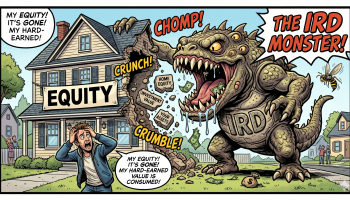
It sounds completely backward. Why would the bank punish you more for having a lower rate? The answer lies in a hidden mechanism called the Original Discount. Here is the raw, unfiltered math behind how big banks turn the IRD penalty into a monster that eats your home's equity.
The Two Penalties: 3-Months' Interest vs. IRD
When you break a fixed-rate mortgage, Canadian lenders typically charge you the greater of two amounts:
- Three months' interest on your remaining balance.
- The Interest Rate Differential (IRD).
If interest rates have dropped since you signed your mortgage, the bank will almost always charge you the IRD. I call the IRD a Poison Pill to keep you from refinancing at lower interest rates. The IRD is designed to compensate the bank for the money they "lose" by lending your funds out to someone else at today’s lower market rates.
To calculate this gap, big banks don't just look at what rate you are currently paying versus what people are paying today. They use an artificial sticker price called the Posted Rate. Each bank has their own unique calculation, but the examples below will get you very close to the actual amount.
Anatomy of the Formula
Behind the scenes, the bank tracks your mortgage using three distinct numbers:
- The Original Posted Rate (The Sticker Price): An artificially high rate that almost nobody actually pays.
- Your Original Discount: The massive "price cut" the bank gave you to match the actual market rate.
- Your Original Contract Rate: The low rate you actually pay every month (Posted Rate minus your Discount).
To try to simplify the calcualtions, I will use these abbreviations:
- Original Posted Rate (OPR)
- Original Discount (OD)
- Original Contract Rate (OCR)
- Current Posted Rate (CPR)
- Current Discount Rate (CDR)
- Interst Rate Differential (IRD)
- Months Remaining in Term (MRT)
- Mortgage Balance (MB)
When you break your mortgage early, the big banks calculate your IRD penalty using these specific calculations:
- OPR - OD = OCR
- CPR - OD = CDR
- OPR - CDR = IRD
- MB x IRD x MRT / 12 = Penalty
Here's an example calculation:
- Original Posted Rate (OPR) = 6.75%
- Original Discount (OD) = 2%
- Original Contract Rate (OCR) = 4.75%
- Current Posted Rate (CPR) 5.25%
- Current Discount Rate (CDR) = 3.25%
- Interst Rate Differential (IRD) = 1.50%
- Months Remaining in Term (MRT) = 36 months
- Mortgage Balance (MB) = $325,000
Or, using the calculations here is a realistic penalty calculation:
- 6.75% - 2.00% = 4.75%
- 5.25% - 2.00% = 3.25%
- 6.75% - 3.25% = 3.50% (or 0.0350)
- $325,000 x 0.0350 x 36 / 12 = $34,125.00
By subtracting your original large discount from today's already-low rates, the bank pushes the comparison floor straight into the basement. The larger your original discount, the lower that floor goes, and the wider the penalty gap becomes. The shorter the remaining term, the smaller the penalty.
The Fair-Market Contrast
To expose just how penalizing the posted rate system is, look at how a non-bank "Monoline" lender calculates the same scenario. These lenders do not use arbitrary posted rates; they simply compare your actual contract rate to today's actual market rate.
If the same client took the mortgage with a Monoline lender instead of a big bank, and the mortgage has a OCR of 4.75%, and they broke their mortgage after 2 years when the current 3-year market rates were at 3.50%, the math changes drastically:
- 4.75% - 3.50% = 1.25% (or 0.0125)
- $325,000 x 0.0125 x 36 / 12= $12,187.50
By using the Posted Rate method, the big banks inflates the penalty from $12,187.50 to $34,125.00—an extra $21,937.50 out of your pocket simply because they chose to calculate the math using their imaginary sticker prices and your original "discount."
A low fixed mortgage rate keeps your monthly payments predictable, but if life events force you to break that term early, that IRD eats a big piece of your equity! Talk to your Mortgage Managers broker about using a Monoline lender for your next mortgage.
Pro Tip
If you are selling your home in Nova Scotia and buying another home somewhere in Canada, you can possibly avoid any penalty by Porting your current mortgage balance to your new home. And, if your mortgage is insured with CMHC or the other insurers, you may be able to Port your insurance premium as well, saving you thousands. Your Mortgage Managers broker can make these arrangements for you.


