Can I Refinance My Mortgage If I’m Self-Employed?
April 22 2026
If you’re self-employed in Nova Scotia, refinancing your mortgage can feel a lot more complicated than it should be.
I’ve been a mortgage broker in Nova Scotia for over 22 years and co-own Mortgage Managers brokerage, and I can tell you this: being self-employed does not disqualify you from refinancing. But it does mean you need the right strategy.
Let’s break down what actually matters—and how to make it work in the real world.
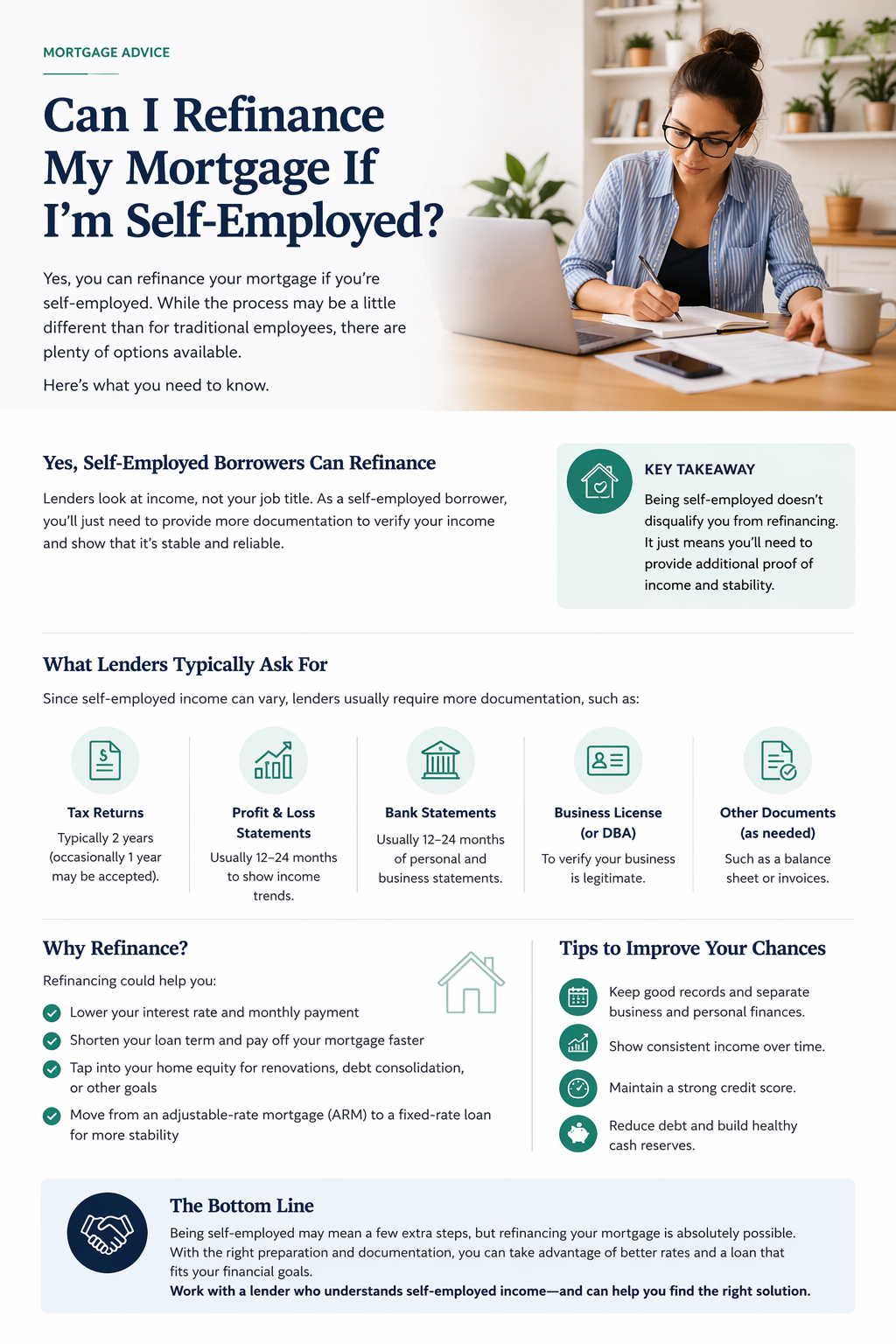
The Short Answer: Yes, You Can Refinance
Lenders don’t care about your job title—they care about income, consistency, and risk.
The challenge for self-employed borrowers is that your income often looks very different on paper than it does in real life.
And that’s where most people run into trouble.
The Real Issue: Your Income on Paper vs. Reality
Most traditional lenders rely on a 2-year average of your Line 15000 income (net income) from your tax returns.
Here’s the problem:
Self-employed clients are often great at minimizing taxes…
…but that can work against you when you apply for a mortgage.
Real Example #1: Health Professional (Independent Contractor)
I recently worked with a client in the health field who was self-employed as an independent contractor.
Like many business owners, she wrote off a significant number of expenses—which is smart from a tax perspective.
But when we looked at her:
2-year average net income on her T1 Generals and Notice Of Assessments (NOA), her Debt ratios simply didn’t work with a traditional bank.
The Solution
We used an alternative lender who looked at her income differently—by reviewing 12 months of business bank statements. This told the real story of her cash flow.
�� Result: She successfully refinanced her home in Hammonds Plains.
Real Example #2: Carpenter with Mixed Income
Another client I worked with was a carpenter.
Some of his income came from smaller “cash jobs”—which, as you can imagine, didn’t fully show up on his tax returns.
So on paper:
- His income looked lower than it actually was
- His ratios didn’t work with traditional lenders
The Strategy We Used
We took a step-by-step approach instead of forcing a bad application:
We set up a second mortgage on his home in Bridgewater, NS to:
- Consolidate debt
- Improve cash flow
- Reduce credit utilization
Over time:
- His credit score improved
- His financial profile strengthened
- When his first mortgage came up for renewal:
- We refinanced and consolidated everything into one mortgage
�� Result: Long-term solution—not just a quick fix.
Why Self-Employed Borrowers Get Declined
From my experience, it usually comes down to three things:
1. Income Looks Too Low on Paper
- Write-offs reduce taxable income—but also reduce borrowing power.
2. Inconsistent Income
- Lenders want stability. Big swings year-to-year can raise concerns.
3. Debt Ratios Don’t Work
- Even strong earners can get declined if their reported income doesn’t support their debt.
What Most Brokers Won’t Tell You
Here’s the honest truth:
- The bank is not always the best option if you’re self-employed.
- A lot of borrowers waste time trying to “fit” into bank guidelines when a better solution exists elsewhere.
Alternative lenders aren’t a last resort—they’re often the right tool for the situation, especially when:
- Income is hard to document traditionally
- You’re in a transition period
- You need flexibility
The key is having a plan—not just a mortgage.
How to Improve Your Chances of Refinancing
If you’re self-employed and thinking about refinancing, here’s what I recommend:
1. Be Strategic About Income Reporting
- Talk to a mortgage professional before filing taxes if refinancing is on your radar.
2. Keep Clean Financial Records
- Separate business and personal accounts. Lenders love clarity.
3. Show Consistency
- Even if income fluctuates, demonstrating a stable trend helps.
4. Manage Debt Proactively
- Lower balances = better ratios = more options.
5. Think in Phases
- Sometimes the best solution isn’t immediate—it’s a 6–24 month strategy.
Why Refinancing Might Make Sense
Self-employed clients typically refinance to:
- Consolidate higher-interest debt
- Improve monthly cash flow
- Access equity for business or personal use
- Move from short-term solutions to long-term stability
The Bottom Line
Yes—you can absolutely refinance your mortgage if you’re self-employed.
But it often requires:
- The right lender
- The right documentation strategy
- And sometimes, the right timeline
After 22 years in this business, I’ve learned this:
There’s almost always a way to make it work—you just need the right plan.
Let’s Talk About Your Situation
If you’re self-employed and not sure what you qualify for—or you’ve been told “no” by your bank—it’s worth getting a second opinion.
Every situation is different, and sometimes a small shift in strategy makes a big difference.
Reach out, and we can map out a plan that actually fits your reality—not just what shows up on paper.


