How can I improve my credit score? A Practical Guide.
September 03 2026
Whether you are preparing to buy your first home, refinancing an existing mortgage, or simply want access to the best interest rates, your credit score is one of the most powerful financial tools you have.
In Canada, credit scores range from 300 to 900. While a score above 650 generally qualifies as "good," pushing your score past 680 opens the door to prime lender pricing, smoother approvals, and thousands of dollars in interest savings over the life of a loan.
Here is an inside look at how Canadian credit bureaus evaluate your profile—and the exact steps you can take to boost your score starting today.
How Credit Scores Work in Canada
Canada has two major credit bureaus: Equifax and TransUnion. While each uses proprietary scoring algorithms, both evaluate your file using five core pillars:
- Payment History (~35%): Do you pay on time, every time? Late payments, collections, or missed balances carry the heaviest penalty.
- Credit Utilization (~30%): How much of your available revolving limit are you using? High balances signal risk, even if you pay in full each month.
- Credit History Length (~15%): How long have your accounts been open? Older trade lines establish reliability.
- Credit Mix (~10%): A healthy blend of revolving credit (credit cards, lines of credit) and installment debt (auto loans, student loans, mortgages).
- New Inquiries (~10%): Applying for multiple new credit facilities in a short window triggers "hard pulls" that temporarily ding your score.
5 Practical Steps to Improve Your Score
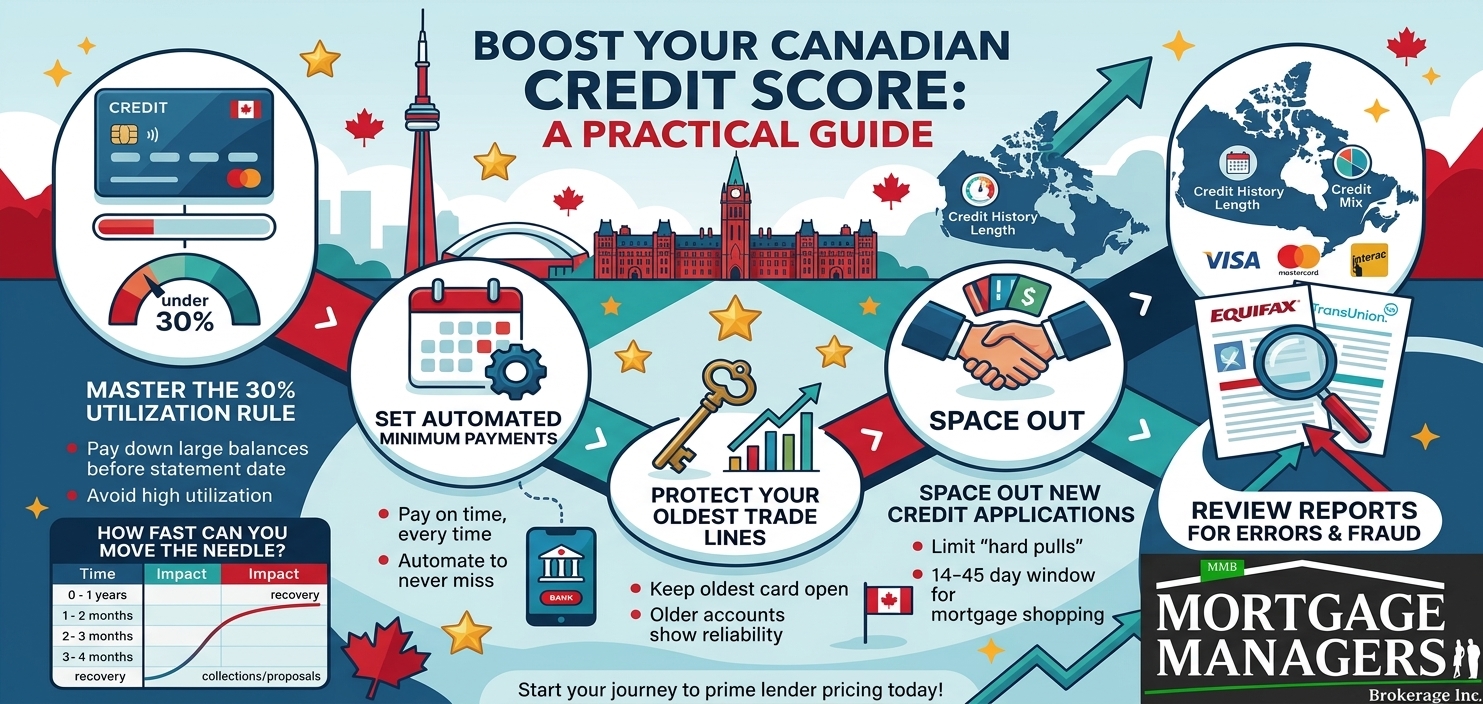
1. Master the 50% Utilization Rule
Your credit utilization ratio measures your current revolving balance against your total credit limit across all cards and lines of credit.
The Target: Keep your balance under 50% of your limit at all times (and ideally under 10% for maximum score points). For instance, on a $5,000 credit limit, keep the balance below $1,500.
The Pro Tip: Credit card companies report your balance on your statement date, not your due date. If you make a large purchase and pay it off on your due date, the bureau may still record a high utilization rate. To avoid this, pay your balance down a few days before the statement closes.
2. Set Automated Minimum Payments
Payment history accounts for more than a third of your score. A single 30-day late payment can knock 50 to 100 points off an otherwise strong score and stay on your report for up to 6 years.
Set up automatic minimum monthly payments for every revolving card or line of credit through your online banking.
Even if you intend to pay off the entire balance manually, an automated minimum ensures an accidental missed date never harms your record.
3. Protect Your Oldest Trade Lines
Length of credit history matters. When cleaning up finances, people often close credit cards they no longer use.
Keep your oldest card open: Closing your first credit card shortens your average account age and reduces your overall available limit, instantly raising your credit utilization ratio.
Put a small recurring subscription (such as a streaming service) on an older card and set it to auto-pay so it remains active.
4. Space Out New Credit Applications
Every time you apply for a credit card, retail financing, or personal loan, the lender performs a hard credit inquiry, which typically drops your score by a few points.
Multiple hard checks within a short timeframe signal financial distress to algorithms.
Note for mortgage shoppers: Canadian scoring models generally group multiple mortgage-related credit inquiries within a 14- to 45-day window into a single inquiry so consumers can shop rates without penalty.
5. Review Your Reports for Errors & Fraud
Roughly one in five credit reports contains reporting errors or outdated entries.
Under Canadian regulations, you can pull your free credit disclosure directly from both Equifax Canada and TransUnion Canada.
Check for misspelled personal details, closed accounts still showing as open/delinquent, or unfamiliar accounts that could indicate identity theft. Disputing and correcting an inaccurate late payment or wrongful collection can result in an immediate score jump.
How Fast Can You Move the Needle?
| Strategy | Expected Impact | Typical Timeline |
|---|---|---|
| Pay down credit card balances below 50% of limit | Significant Boost | 30-60 days depending on reporting cycle |
| Fixing reporting errors/disputes | Moderate to High Boost with proper documentation | 5 to 10 days |
| Recoving from a single late payment | Gradual recovery | 6-12 months of clean credit |
| Rebuilding after collections, Proposal, or Bankruptcy | Steady climb | 12-24 months with new trade lines |
The Bottom Line
A credit score is not a static grade—it is a rolling snapshot of your financial habits. With focused attention on low balances, automated on-time payments, and disciplined credit usage, you can make meaningful improvements within just a few billing cycles.


