How can I improve my chances of getting approved if I have bad credit?
May 12 2026
Buying a home in Nova Scotia is one of the most significant financial milestones in life, but if your credit score isn’t where you want it to be, the process can feel overwhelming. The good news is that "bad credit" doesn't have to be a permanent "no"—it’s often just a "not right now" or a "let’s look at different options."
In today’s 2026 mortgage landscape, there are several pathways to homeownership in Nova Scotia, even if your credit history has some bruises. Here are the most effective ways to improve your chances of approval.
1. Boost Your Score with Strategic Habits
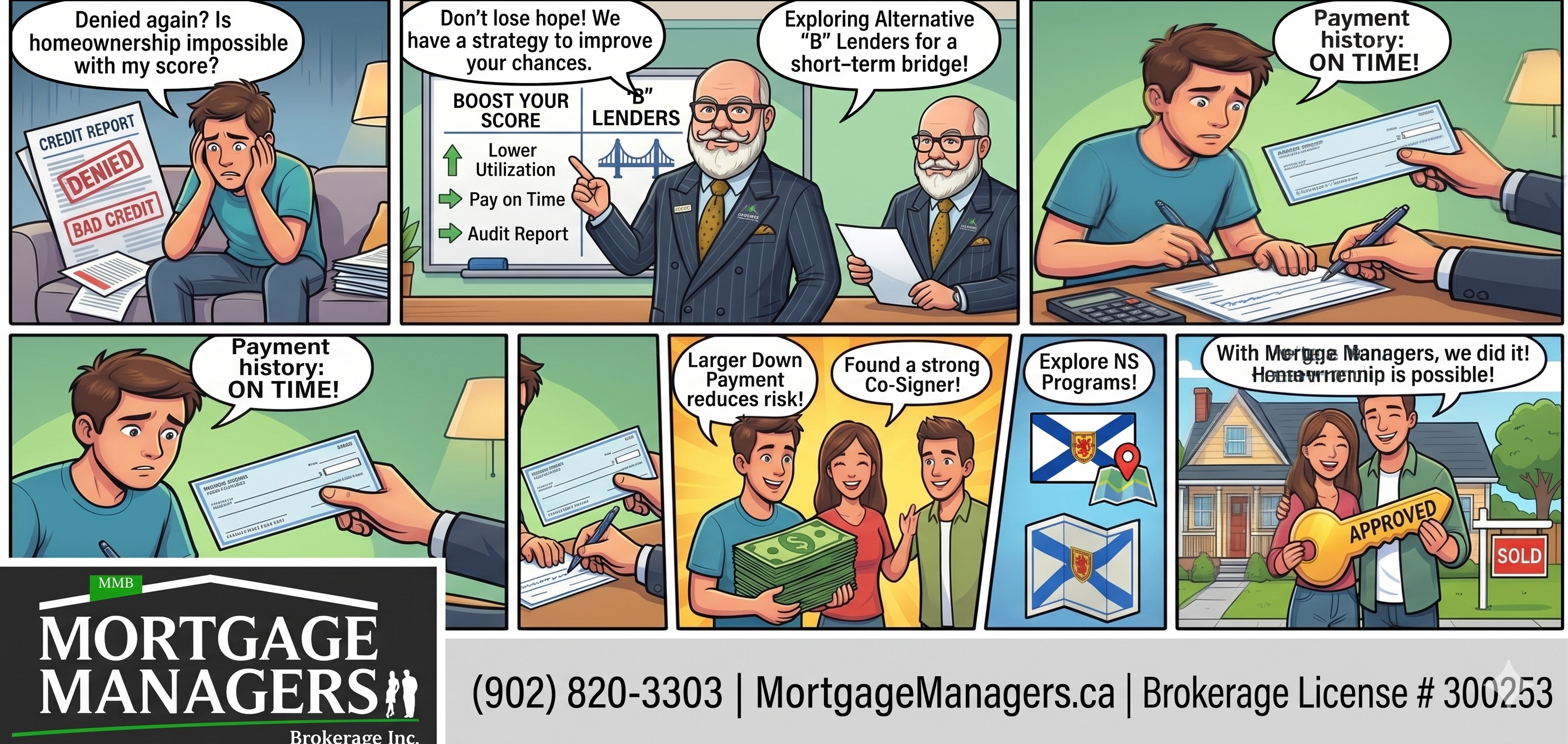
Your credit score is a snapshot, not a life sentence. Small, consistent changes can yield significant results in a relatively short window:
The 50% Rule: Keep your credit card balances below 50% of their limits. If you have a $10,000 limit, try to keep the balance under $3,000. Lenders view high utilization as a sign of financial stress. Alternativly, you coud try to ask your credit card company to increase your credit limit so that the current balance becomes 50% of the new limit.
You will need at least 2 pieces of credit, like a credit card and/or a personal loan, with a credit limit of at least $2,500 to be considered a "real" piece of credit.
Wait until your most recent late payment is more than 12 months ago so that you can show that you are back on track with a clean credit history for a full year.
Prioritize Payment History: This accounts for roughly 35% of your score. Even if you can only make the minimum payment, doing so on time every single month is critical.
Audit Your Report: Errors are more common than you think. Request a copy of your report from Equifax or TransUnion and dispute any inaccuracies, such as debts you’ve already paid or accounts that don't belong to you.
2. Consider Alternative "B" Lenders
If Canada’s major banks (A lenders) aren't an option due to a score below 600–650, alternative lenders—often called B lenders—can be a bridge.
These institutions are more flexible regarding credit scores and non-traditional income. While interest rates are typically 1–2% higher than prime rates, these mortgages are often designed as short-term (1–3 year) solutions. The goal is to get you into the home now, rebuild your credit while making mortgage payments, and then switch to a prime lender when your term renews.
3. Leverage a Larger Down Payment
In the mortgage world, equity equals safety. If you can provide a down payment of 20% or more, you decrease the lender's risk. This can often offset a lower credit score because the lender has more security in the property itself.
4. Find a Co-Signer
A co-signer with a strong credit profile and stable income can significantly bolster your application. The lender will consider the co-signer’s creditworthiness alongside yours, which can bridge the gap to an approval at a much better interest rate.
5. Buy a home in or near a major town or city
Alternative lenders will take a risk on you, your credit, or your job/income, but they offset that risk by primarily only financing homes in popular areas near Halifax, Bedford, Dartmouth, Sackville so that if you default, they can sell the house fairly quickly. If you have a larger down payment, more rural towns may be an option. Alternative lenders will not finance a mobile home in a trailer park on leased land.