Renting to Owning: Every First-Time Home Buyer Program in Nova Scotia Explained
May 31 2026
Saving for a down payment while dealing with today’s rental market can feel like trying to run a marathon in quicksand. It is no secret that rising costs have made the traditional path to homeownership incredibly frustrating for first-time buyers right here in Nova Scotia.
But here is the good news: the rules are changing in your favor. Between groundbreaking new provincial pilot programs that slash down payment minimums, interest-free loans, and powerful federal tax shelters, there are more pathways available to help you stop paying a landlord and start building your own equity. Let’s break down exactly what programs are on the table, how they work, and how you can combine them to get the keys to your first home much sooner than you think.
The Fine Print: Who Actually Qualifies as a "First-Time Buyer"?
Before diving into the money, let’s clear up a common misconception. You do not have to have never owned a piece of dirt in your life to count as a first-time buyer. Under almost all provincial and federal program definitions, you qualify if:
You have never owned a home before, OR
You have not occupied a principal residence that either you or your current spouse or common-law partner owned in the last 4 consecutive years.
If you went through a life change or have rented for the last four years, you are wiped clean and considered a first-time buyer all over again.
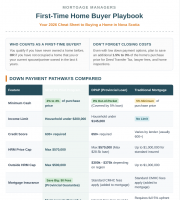
You can find a downloadable copy of out First Time Home Buyer Playbook in our Library at First Time Home Buyers Playbook
1. Nova Scotia Provincial Programs: Breaking the 5% Down Barrier
Historically, if you wanted to buy a home in Canada, you needed at least a 5% down payment from your own resources. The provincial government has introduced two distinct paths to bypass or satisfy this rule.
Pathway A: The New 2% Down Payment Pilot Program
Launched to tackle the housing affordability crisis, this joint initiative between the Government of Nova Scotia and local participating Credit Unions is a total game-changer.
The Magic: It officially slashes the minimum required down payment from 5% down to anywhere between 2% to 4%. On a $500,000 home, that drops your required cash savings from $25,000 to just $10,000.
The Big Hidden Bonus: Typically, putting down less than 20% means you are slapped with thousands of dollars in CMHC default mortgage insurance premiums. Under this pilot program, the Province acts as your guarantor, meaning you pay $0 in mortgage default insurance fees.
The Catch: This is a localized credit union product. National big-five banks do not offer it. Furthermore, you cannot borrow the remaining 2% down payment; it must come from your own resources or an eligible gift.
Core Requirements: Maximum household income under $200,000, a credit score of 630+, and a maximum purchase price of $570,000 in the Halifax Regional Municipality (HRM) and East Hants (capped at $500,000 throughout the rest of the province).
Pathway B: The Down Payment Assistance Program (DPAP)
If you don't even have 2% saved up but have great credit and stable income, DPAP is your alternative route.
The Magic: The province gives you an interest-free loan of up to 5% of the home’s purchase price to act as your complete down payment. This means you can essentially walk into a purchase with $0 out-of-pocket for the down payment itself.
The Repayment: You repay this interest-free loan over a fixed 10-year term. For example, a $20,000 DPAP loan breaks down to a very manageable $167 per month.
Core Requirements: This program targets modest-to-middle income earners, capping total household income at $145,000 or less. You need a credit score of 650+ and must already be pre-approved for a standard insured mortgage through an approved lender. The purchase price cap matches HRM at $570,000 (max $28,500 loan) but scales down lower to $300,000–$375,000 in rural and eastern regions of Nova Scotia.
2. Federal Stacking Tools: Maximizing Your Tax Shields
Provincial down payment help works even better when paired with Canada’s newest tax-sheltered savings accounts and credits.
The First Home Savings Account (FHSA): If you aren't buying this exact month, you need to open an FHSA immediately. You can contribute up to $8,000 per year (up to a $40,000 lifetime max). The money you put in acts as a tax deduction (lowering your annual income tax bill), and when you withdraw it to buy your home, it comes out completely tax-free. It's the ultimate hybrid of an RRSP and a TFSA.
The RRSP Home Buyers’ Plan (HBP): The federal government allows first-time buyers to withdraw up to $60,000 tax-free from their existing Registered Retirement Savings Plans (RRSPs) to put toward their home. If you are buying with a partner, that’s a combined $120,000. You have 15 years to start paying it back into your RRSP.
The First-Time Home Buyers’ Tax Credit: A straightforward non-refundable tax credit that gives you up to $750 right back into your pocket when you file your income taxes the year you buy your home. This helps offset moving day costs.
GST/HST New Housing Rebate: Planning on buying a brand-new build or a major renovation project from a builder? You may qualify for a rebate of up to 36% of the federal GST paid on homes priced under $350,000, with a partial sliding rebate capping out at $450,000.
Pro-Broker Tip: Budgeting for the "Other" Costs
When I sit down with buyers, the biggest mistake I see them make is spending every last dime of savings on the down payment. In Nova Scotia, lenders require proof that you have an extra 1.5% to 3% of the purchase price set aside in cash for closing costs.
Between the Nova Scotia Deed Transfer Tax (which is 1.5% in HRM), legal fees, title insurance, and a quality home inspection, these costs add up quickly. If you use a program like DPAP or the 2% down pilot to lower your upfront down payment footprint, it frees up that vital cash to safely cover these closing costs without running up credit card debt.
The Bottom Line: Let's Map Your Path
There is no "one-size-fits-all" answer. If your household income is $160,000 and you have excellent credit, you might lean heavily into the 2% Credit Union pilot. If you have stable employment but have struggled to build up cash reserves due to high rent, the DPAP interest-free loan could be your path forward.
Navigating the combinations, the stress tests, and lender guidelines shouldn't be done alone.
Ready to see what you qualify for? Let’s run your numbers together, look at your household income, and find the exact program stack that will save you the most money upfront.
Call Directly: (902) 820-3303
Visit Us: mortgagemanagers.ca
Stop By: 2241 Hammonds Plains Road, Hammonds Plains, NS


