Before the Train Wreck: Why Washington’s Debt and Tokyo’s Fragility Dictate Canadian Mortgage Rates
September 09 2026
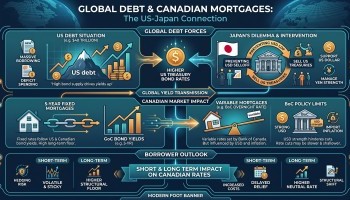
When Canadians renew or apply for a mortgage, they usually look to the Bank of Canada (BoC). But the cost of Canadian home loans is increasingly decided thousands of miles away: driven by the United States’ spiraling debt pile, relentless US Treasury bond issuance, and Japan’s fragile role as Washington’s largest foreign creditor.
The mechanics connecting Washington, Tokyo, and a mortgage contract in Halifax or Cape Breton break down into distinct short and long-term impacts.
The Domino Chain: How Global Debt Reaches Canada
The U.S. Supply Problem: With the U.S. national debt crossing record territory, the U.S. Treasury must issue an avalanche of new bonds to fund ongoing deficits and interest obligations. Basic supply and demand applies: when bond supply overwhelms buyer appetite, bond prices fall and yields (interest rates) spike.
The Japan Dilemma: Japan holds over $1 trillion in U.S. debt. As the Bank of Japan (BoJ) normalizes interest rates, Japanese institutional investors have less incentive to buy U.S. debt; on a currency-hedged basis, domestic Japanese yields are increasingly competitive. To prevent a disorderly selloff of Treasuries and currency chaos (the unwinding yen "carry trade"), Washington and Tokyo must coordinate carefully. If Japan reduces its purchases or liquidates Treasuries, U.S. yields surge even higher.
The Spillover into Canada:
Fixed Mortgages: Government of Canada (GoC) 5-year bond yields closely track U.S. 10-year and 5-year Treasury yields due to capital mobility. When U.S. yields rise, Canadian bond yields are dragged up with them, directly raising the funding costs of Canadian 5-year fixed-rate mortgages.
Variable Mortgages: Variable rates follow the Bank of Canada’s target overnight rate. However, if U.S. yields stay elevated and keep the U.S. dollar strong, the BoC cannot aggressively decouple or slash rates without crushing the Canadian dollar ($CAD), which would import inflation.
Short-Term vs. Long-Term Impacts on Canadian Mortgages
| Mortgage Type | Short-Term Outlook | Long-Term Outlook |
|---|---|---|
| Fixed Rates (Driven by GoC Bond Yields) | Sticky & Volatile: As Treasury auctions struggle with heavy supply and Japanese carry-trade jitters flare up, bond yields will face recurrent upward shocks, keeping 3-year and 5-year fixed rates stubbornly higher than typical economic slowdowns warrant, | Permanently Higher Floor: A global structural shortage of buyers for sovereign debt forces a higher "term premium." The ultra-cheap 2% fixed-rate environment of the 2010s will not return; long-term fixed rates remain bound to elevated global yields. |
| Variable Rates (Driven by BoC Policy Rate) | Divergence Friction: Even if domestic economic slack calls for Canadian rate cuts, the BoC will be constrained by the $CAD/$USD exchange rate spread. Variable rate relief may arrive slower and in smaller increments than borrowers hope. | Cyclical Reset: Once inflation stabilizes, variable rates will reflect domestic economic cycles, but the neutral policy rate will sit higher than in the pre-2020 era due to higher global baseline borrowing costs. |
Key Takeaways for Canadian Borrowers
- The Bank of Canada doesn't control fixed rates: Even if the BoC cuts its key overnight rate, fixed mortgage rates can refuse to drop (or even move up) if U.S. bond markets are selling off.
- The "Floor" has moved: The era of ultra-cheap money was heavily subsidized by foreign central banks (like Japan) soaking up U.S. debt at rock-bottom yields. With Japan stepping back and U.S. deficits expanding, global capital costs more, making higher mortgage carrying costs a structural reality rather than a temporary blip.


